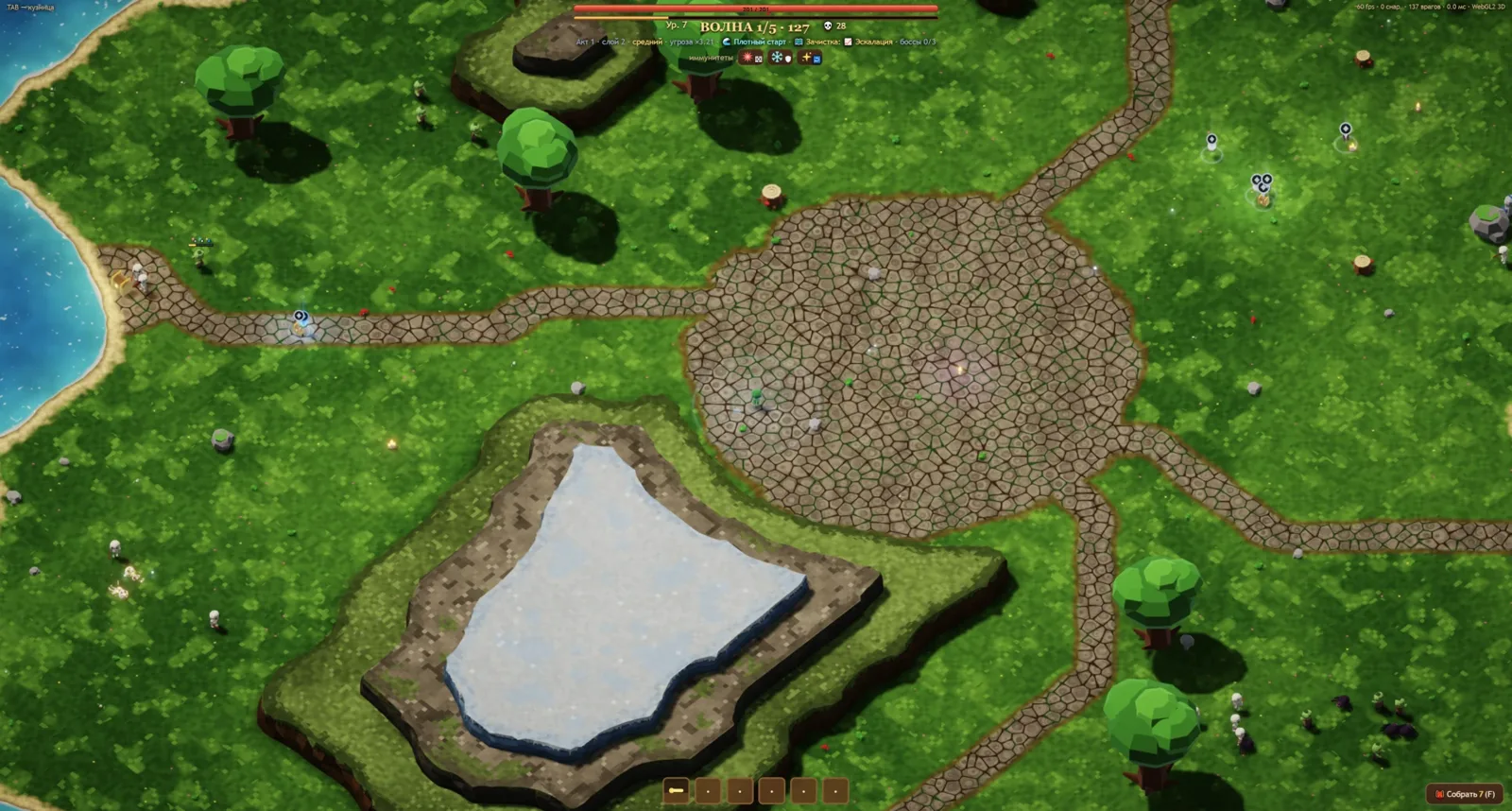
The arena used to be an endless field. Now each run builds an island: water around the edges, cliffs in tiers
of grass, stone and glacier ice, forests, stone plazas and roads running down to the shore. Enemies walk around
the cliffs instead of through them and come ashore from the sea. Shots that fly behind a cliff stay faintly
visible, so you never lose track of your own build.
A generated island: roads, a plaza and a glacier-capped plateau.
Two ways to fight: Classic and Clear
Each node on the campaign map now says how its run plays. Classic is the familiar rising stream of
enemies around you. Clear is new: the whole wave is already standing across the island in packs, and no
one spawns next to you. Monsters wander near home and only charge when they see you, when you hit them,
or when someone from their pack raises the alarm. Clear a wave and the next one arrives; bosses come between
waves. Enemy camps guard chests.
Loot waits for you
Experience still flies to you on its own. Skills, modifiers and gear now stay where they fell until you press
Collect — the button shows how many items it will grab. Nothing is lost: the gear bag holds 500 items,
and when it is full, the extra simply waits on the ground. Arrows at the screen edge point to loot you can't see,
in the colour of its rarity.
The beam is instant now
A beam no longer lingers: damage and everything plugged into it happen the moment it fires. So modifiers that
would make other skills last longer or fly faster make the beam longer instead, and area bonuses make it
thicker. Curved paths changed too: a zigzag is now a clean staircase, a spiral is a real spiral that
opens up, and speed no longer bends the shape.
Each skill's shots look like that skill
Arrows look like arrows, seeds are green, orbs are violet. Every projectile type has its own shape, colour,
glow and tail, and heavy shots — the ones that carry a lot of damage — glow hotter. The shapes come from Blender
and can go back to it for editing; the Archer's arrow is the first one made by hand.
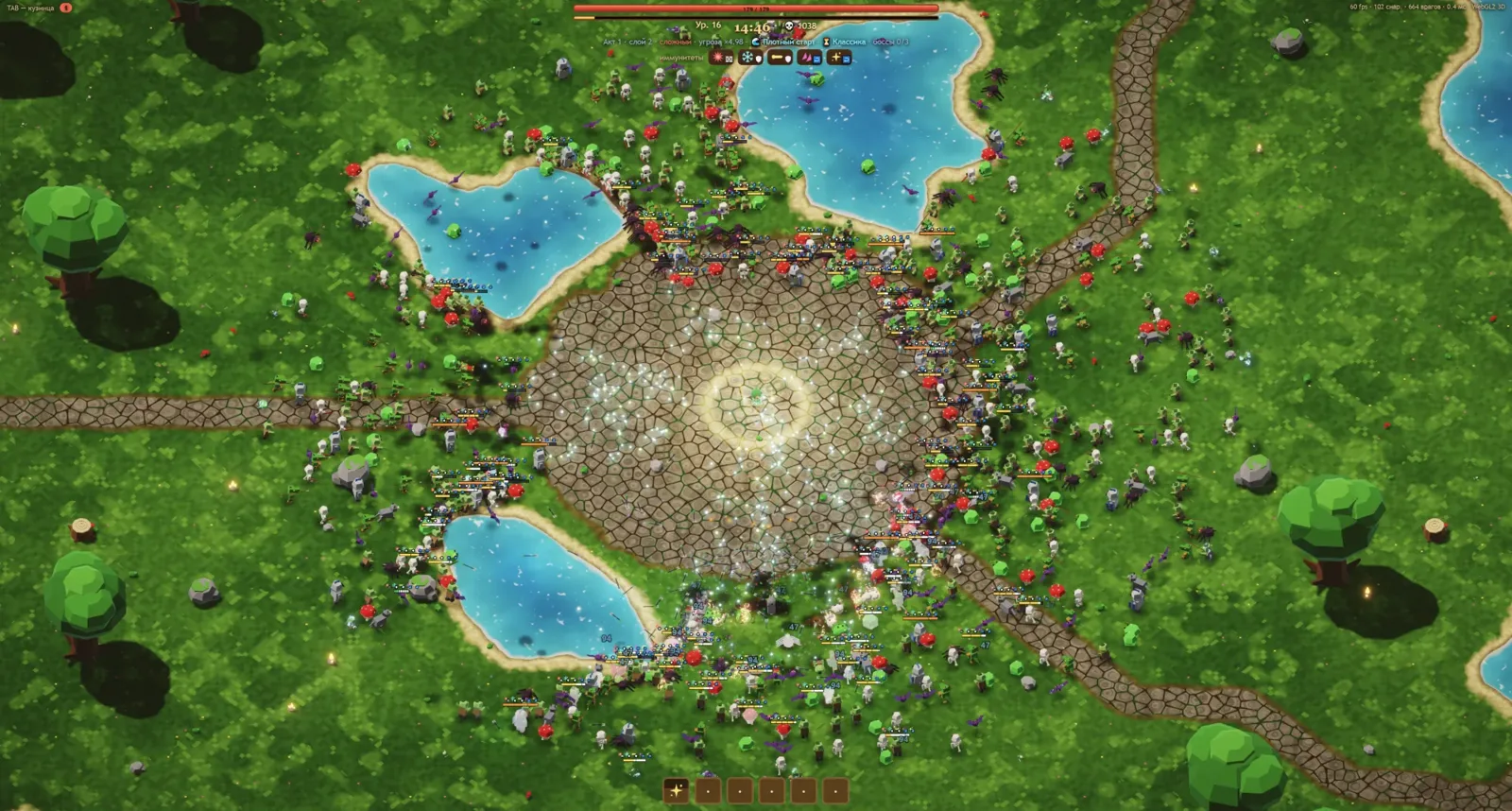
The biggest change so far. Until now the game was drawn flat, with sprites and emoji. In two weeks it moved to
an isometric 3D world: models, animation, light and shadows, glowing effects. Everything underneath — skills,
the forge, saves, gear, gamepad — stayed the same. The flat version is retired.
The same crowd, now in 3D.
From Blender into the game, and back
A Blender add-on now sends a model into the game with one button: skeleton, animations, glow colour,
shininess. Any model can also be exported from the game back to Blender. A built-in lab shows each hero,
enemy and effect on a clean stage, with its idle, walk, attack and death poses. Several heroes, the
treasure chest and the boss Overlord already have models made for the game.
A new enemy and things in the way
The Lizardman joins the crowd from the 90-second mark. Trees, boulders and stumps now stand on the arena:
you and the enemies have to walk around them, while shots fly over.
Still smooth on a phone
3D is heavier, so we measured everything. On a phone, past 500 enemies the crowd switches to simpler
models; piles of
explosions are thinned out so a dense fight stays readable instead of turning white. New games ask how many
projectiles your device should handle — from 500 to 60,000 — and the game can test your device and pick the
number for you.
Our own icons
Emoji were placeholders and some of them didn't even show up on older Windows. Every skill, modifier and piece
of gear now has its own drawn icon — over forty so far.
Put any two path modifiers on a skill and they combine: spiral plus zigzag gives a twisting, weaving shot.
Orbit turns the others into changes of its radius — the ring breathes, pulses or reaches out toward enemies.
A boomerang always comes back to you, wherever you've run. Aim modifiers stack the same way, and the order of
modifiers in their sockets no longer matters.
Modifiers you tune yourself
Two new modifiers open a window of sliders instead of giving a fixed bonus: one for the skill (damage, size,
lifetime, pull), one for its path (spread, spiral twist, zigzag size). They can't make a skill stronger than it
already is — they let you move power where you need it: a tighter spiral, a denser explosion, an earlier chain.
Gear
Enemies now drop gear for eight slots: weapon, head, body, legs, boots, two rings and an amulet. From epic
rarity up, gear can change the skill tree itself — more damage for nested skills, a better chance for them to
fire, one more level of recursion. Three equal pieces merge into a better one. Bosses sometimes drop golden
uniques. Character levels now last one run; gear and skills stay with you.
Gamepad everywhere
Move with the left stick, aim with the right — and the forge, the gear screen and every menu work without a
mouse. While you play with a gamepad, hints show its buttons instead of keys. The game also got its own
desktop window.
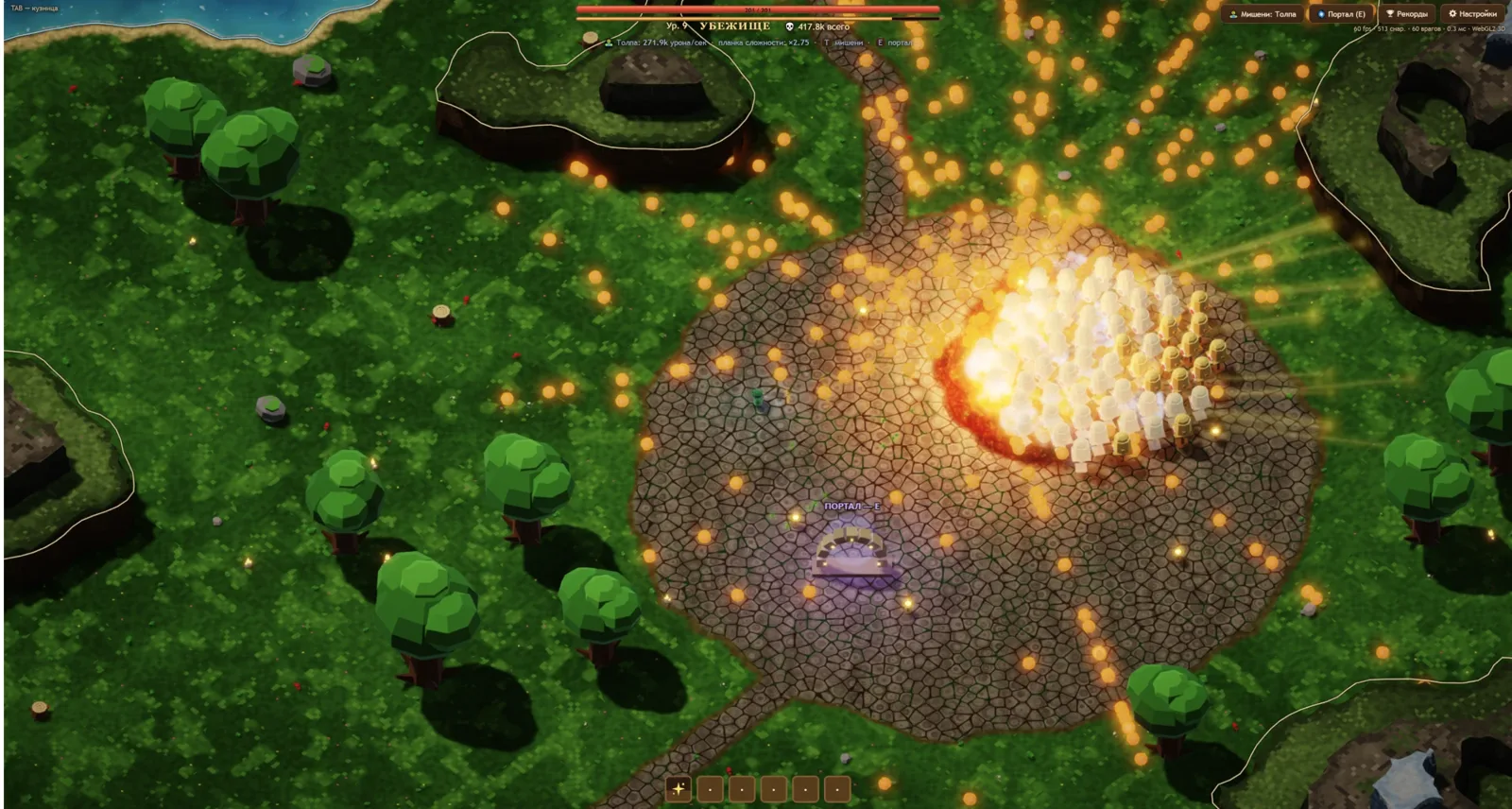
A burning build could leave a hundred small fire patches on the ground, each with its own outline — a mess.
Now they merge into one glowing area of heat, and the explosion is drawn on top of it. Explosions and sword swings
got several looks to choose from, tried side by side in an effects lab before going into the game.
Explosion over a field of embers.
A sandbox
A separate mode with a creative forge — any skill, any rarity — training dummies and a time-speed slider.
It's where builds get tested and balance gets checked. Saves moved to proper files with slots, export and import.
On a phone
The first finger anywhere on the screen is the movement stick, the second one aims. Two fingers zoom, a long
press shows a tooltip, and buttons sit in the corners. Every menu, the map and the forge were reworked for
both portrait and landscape.
Every five minutes the spawning stops and a boss walks in: one, then two, then three. They can't be deleted in
one volley — a boss loses at most a tenth of its health per second. Their area strikes are telegraphed with a
filling outline, and no single hit can kill you; a series of missed dodges can. The run ends only when the last
boss falls, and then you get time to pick up everything they dropped before stepping through the portal.
Five heroes, one skill each
The Archer, the Igniter, the Frost Keeper, the Blade and the Conductor. Each starts with exactly one skill
and one modifier — everything else comes from enemies. New enemies make the crowd smarter: an armoured knight
that shrugs off weak hits, a healer that keeps its neighbours alive, spores that split, and a courier that
runs away but always drops an item if you catch it.
Rarity decides whether nested skills fire
A skill in your hero's slot always fires. A skill plugged inside another one now fires by chance: 40% for
common, up to 100% for mythic. Long chains of junk items break easily; long chains of good items are
devastating. Recursion was reworked too: it used to grow damage so fast that nothing else mattered, now it is a
strong but steady multiplier.
The black hole
A new kind of skill. It pulls enemies in, burns everything inside and collapses at the end with a hit that
grows with every enemy it caught. Whatever is plugged into it fires when an enemy crosses the glowing ring.
Enemies learn
After every win, the enemies remember the three skills that hurt them most in the final wave. Next time
those skills meet armour, toughness or full immunity — and on later layers some skills can even heal enemies or
cut your chains. You see all of this on the map before you enter a node. The run report now shows how much
damage every skill dealt, so you know exactly what will be remembered.
The game started from one question: what if an upgrade wasn't a choice from a menu, but a wire you plug into
another skill?
The first version had the core that is still there today. Every skill is a node with two hooks — on hit
and on expire — and you can plug any other skill into them, as deep as you like. You assemble the chain
in the forge, while the game waits. Everything you build with drops from enemies, rarity has no upper limit,
and three equal items merge into one better one.
A couple of days later runs got an end. An endless arena with endless growth gets boring fast, so a run became
fifteen minutes with a final wave, and runs were tied together into a campaign map of layers with easy, medium
and hard paths. The difficulty follows you: win easily and the next node jumps up; barely survive and it grows
a little. Upgrades fade with stacking — the hundredth damage boost is weaker than the first — so growth never
stops but never explodes either.
The first entries were written looking back at the first two months of work.